Airports have gotten good at measuring restrooms, security lines, and gates. Concessions are still mostly a blind spot.
That gap matters more every year. Passenger spending per head has been under sustained pressure, and terminals depend on that spending to fund the experience investments passengers actually notice.
Average travel retail spend per passenger peaked at $24.30 in 2020 and has been falling since, landing around $15.50 — roughly 17% below pre-pandemic levels even as passenger volumes recover (Kearney, 2024). More people are moving through terminals. Fewer of them are stopping to spend, and fewer still are having their concession experience measured at all.
Real-Time Feedback Stopped at the Gate
Most airport feedback infrastructure was built around the touchpoints that are easiest to instrument: restrooms, security checkpoints, gate areas. Physical devices in fixed locations, tied to fixed foot traffic.
Concessions don't fit that model as neatly. A food court has dozens of vendors under one roof. A duty-free zone has browsing behavior that doesn't map to a single queue. A coffee kiosk turns over customers every ninety seconds.
The result: the part of the terminal generating meaningful non-aeronautical revenue is often the part with the least real-time visibility into how the experience is actually landing.
What a Mid-Size Hub Airport Is Already Solving For
In FeedbackNow customer conversations, a mid-size European hub airport described exactly this gap during a feedback system tender: its current setup reacts too slowly and doesn't extend into partner-operated zones like food and beverage.
Its plan wasn't to add more restroom devices. It was to add lightweight QR-code feedback zones directly inside F&B areas — points that don't require new hardware infrastructure, can be relocated easily during terminal construction, and extend real-time measurement into space the airport doesn't operate directly but is still accountable for.
Why QR Zones Solve a Different Problem Than Buttons
A smiley-button device works well at a fixed chokepoint: a restroom exit, a security lane, a gate podium. It asks one question, once, right after a defined moment ends.
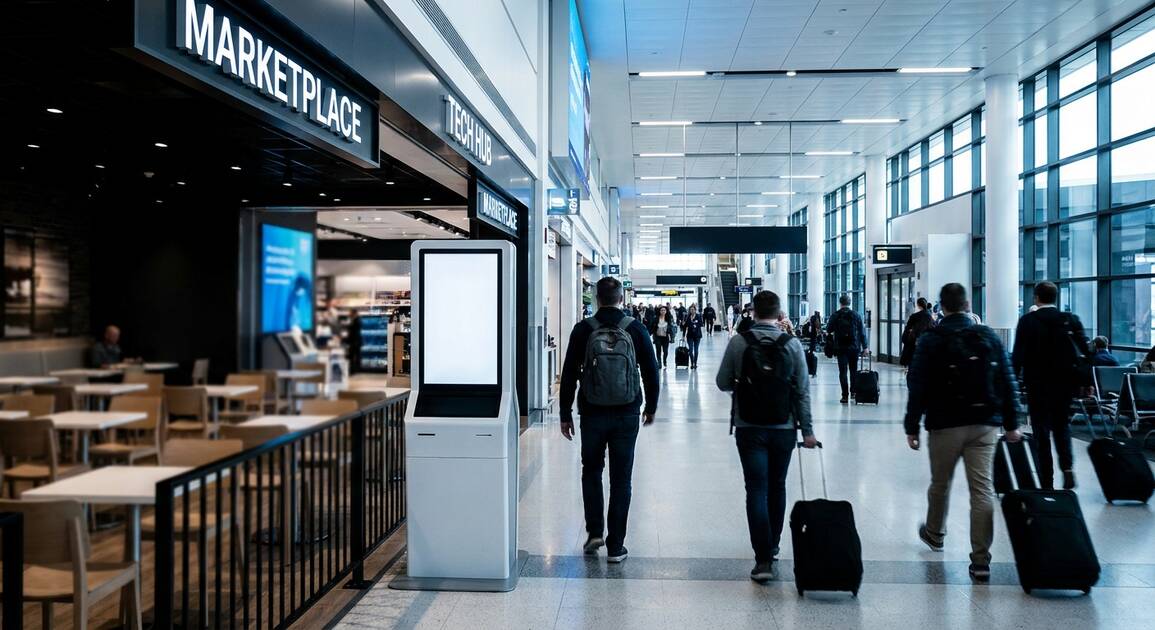
Concessions need a lighter-weight layer. A QR code on a table tent, a receipt, or a menu board lets a passenger respond on their own device, on their own timing, without an airport needing to hardwire a device into a vendor's leased space. It scales to as many stalls as a food court has, without a matching hardware rollout.
That flexibility is what makes it possible to close the loop with concessionaires who operate under separate leases, separate staff, and separate incentives from the airport itself.
Concessions Feedback Still Belongs to the Airport
Passengers don't distinguish between airport-operated and vendor-operated space. A bad experience at a food court reflects on the terminal, regardless of who holds the lease.
That means an airport's operational experience software has to reach every operator under its roof — not just the zones it directly controls. A feedback program that stops at the boundary of directly operated space is measuring less than half of what actually shapes a passenger's impression of the terminal.
Turning a Revenue Pressure Point Into an Experience Signal
Declining spend per passenger is often framed as a marketing or pricing problem. Some of it is an experience problem hiding in plain sight.
A passenger who has a frustrating concession experience — a long line with no visible staff, a kiosk that's out of stock, unclear signage to find a specific vendor — is less likely to spend, and less likely to try again on a future trip through the same terminal. Real-time feedback at these zones turns an invisible drag on revenue into a specific, addressable signal: which vendor, which time of day, which recurring complaint.
A Regional Airport's Version of the Same Gap
A regional airport with a single small food court has less room to absorb an underperforming concession relationship. One vendor with a slow line or inconsistent quality has an outsized effect on the entire terminal's experience, simply because there are fewer alternatives nearby.
For an airport like this, extending real-time feedback into concessions isn't a nice-to-have addition to an existing program. It's coverage for the touchpoint most likely to define a passenger's last impression before boarding.
The Loop Has to Close Somewhere
A concessionaire operating under a five-year lease has every incentive to know if something is going wrong at their stall today, not at lease renewal. A QR-based signal that reaches both the airport and the vendor closes that loop for everyone accountable for the experience.
The Bottom Line
Concessions generate real revenue and shape real impressions — and most airport feedback programs still don't reach them.
Extending real-time feedback into F&B and retail zones, through lightweight channels built for that space, closes the last major gap in full-journey passenger measurement.
See how real-time feedback covers every terminal touchpoint →
Contact us to learn more about how FeedbackNow can help improve your customer experience and operations!