Nurses are not the right escalation point for a cold meal, a housekeeping request, or a broken TV remote. But they handle these calls constantly.
Research shows nurses spend between 40% and 56% of their shift on direct patient care (Nurse Workload and Patient Safety, ResearchGate, 2024). The remaining time — close to half of every shift — goes to documentation, coordination, and non-clinical tasks.
Non-clinical task handling is a significant share of that overhead. And most of it is preventable.
The Non-Clinical Escalation Pattern
When a patient has a non-clinical need — a request for housekeeping, a meal delivery issue, a maintenance concern, or a comfort request — the typical resolution path runs through nursing.
The patient activates the call light or tells a nurse directly. The nurse records the request, identifies the responsible department, contacts that department, and follows up to confirm resolution. In a high-census unit, this cycle can consume 8–12 minutes per request.
Multiply that by the volume of non-clinical requests in a 24-bed unit during a 12-hour shift. The math compounds quickly.
This is not a staffing problem. It is a routing problem.
The nurse is not the right first responder for a housekeeping call. They are the closest available point of contact — because the patient has no other operational channel.
Real-time feedback systems change that equation directly.
What a Real-Time Feedback Layer Does Differently
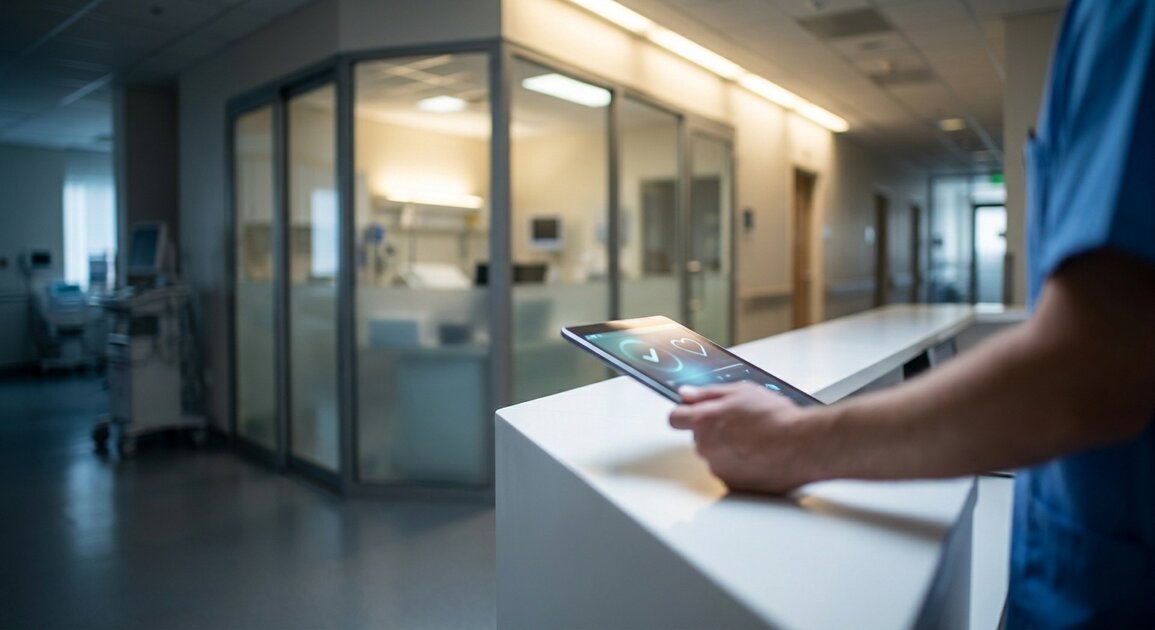
A patient experience feedback system deployed at the bedside, room exit, or unit-level touchpoints does more than collect satisfaction data.
It creates a direct operational channel between the patient and the department responsible for their non-clinical experience.
When a patient rates housekeeping services below threshold, that signal routes automatically to the EVS supervisor — not to the nursing station. When a meal score drops below threshold in a specific wing, the alert reaches dietary services. When a comfort issue is flagged in a waiting area, facilities receives the notification.
Nursing is removed from the non-clinical escalation path. Not because patient needs are deprioritized — because they are being routed to the team that can actually address them.
According to FeedbackNow customer research, hospitals that deploy real-time feedback routing to EVS, dietary, and facilities teams report a reduction in non-clinical nursing task volume of approximately 30% within the first quarter of deployment. Nurses report more time for direct patient care. Unit managers see improved response cycle times for non-clinical requests.
The benefit is operational. The HCAHPS impact follows from it.
The HCAHPS Responsiveness Connection
HCAHPS measures responsiveness of hospital staff as a composite domain. Specifically, it captures how often hospital staff responded to calls quickly enough that patients felt attended to.
The responsiveness score is not driven exclusively by clinical response times. It is driven by the total experience of whether any need — clinical or non-clinical — received a timely response.
A patient whose housekeeping request sat unresolved for 45 minutes before a nurse intervened will score responsiveness lower. Not because nursing was slow — but because the request never reached the right team in time.
Real-time feedback routing is a direct HCAHPS responsiveness intervention. It compresses the gap between when a patient signals a need and when the responsible department receives it.
The nursing staff is freed from routing overhead. The patient receives a faster response. The HCAHPS responsiveness composite improves — not because anything was changed about nursing care, but because the non-clinical escalation path was made direct.
The Broader Operational Shift
Reducing nursing non-clinical task burden has a compounding effect beyond HCAHPS scores.
When nurses spend less time on non-clinical coordination, they spend more time at the bedside. Patient perception of nurse attentiveness improves. Communication scores improve. The HCAHPS perception of care quality rises — driven not by training programs or scripts, but by the structural change of routing the right requests to the right teams.
This is what operational infrastructure does that satisfaction surveys cannot. Surveys measure the outcome. Real-time feedback systems produce the outcome.
The Bottom Line
Nursing non-clinical workload is a signal problem. Nurses are handling requests they were never meant to handle because the patient has no direct operational channel to the responsible department.
Real-time patient feedback systems create that channel. Non-clinical requests route directly to EVS, dietary, and facilities — bypassing nursing entirely. Response times compress. Nursing capacity returns to direct care. HCAHPS responsiveness scores improve.
The mechanism is operational. The results are measurable.
Contact us to learn more about how FeedbackNow can help improve your customer experience and operations!