A patient's experience of care happens in a moment. The measurement of it usually happens weeks later.
That gap is not a data problem. It's a design problem.
HCAHPS surveys arrive after discharge, filtered through memory, and answered by a shrinking share of patients. What's left is a lagging indicator dressed up as an operational tool. Hospitals act on it anyway, because for decades it was the only signal they had.
It no longer has to be.
The Survey Was Never Built for Speed
Surveys are designed for statistical validity, not operational response. By the time a discharge survey comes back, the nurse, the room, the shift — all of it has changed.
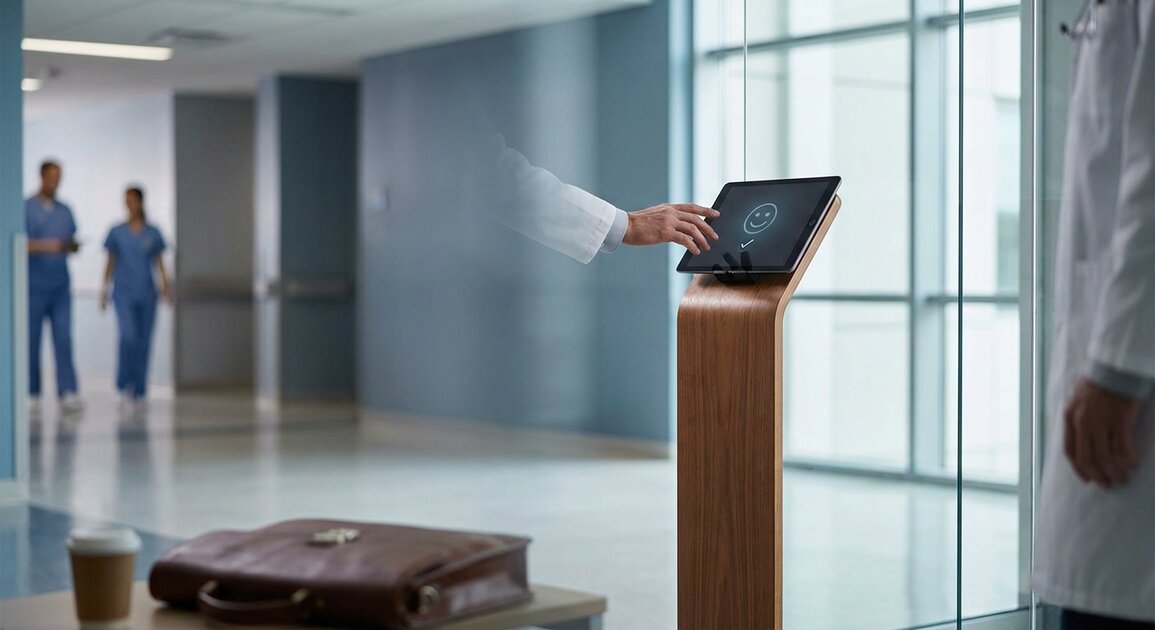
Feedback devices placed at the point of care work differently. A patient presses a button in real time, while the experience is still happening. The signal reaches a staff member before the moment is gone, not after it's been reconstructed from memory.
This is not a philosophical distinction. It changes what's possible operationally: a dissatisfied signal at 2pm can trigger a service recovery visit at 2:05pm, not a root-cause review three weeks later.
The Evidence Is Not Anecdotal
A randomized study published in the Journal of General Internal Medicine tested exactly this mechanism: real-time feedback delivered to providers, with peer benchmarks, instead of delayed survey results.
The result: providers who received real-time, point-of-care feedback signals achieved 86% "always communicates well" scores from patients, compared to 80.5% for providers who did not — a statistically significant gap (Surani et al., JGIM, 2022).
Same providers. Same hospital. The only variable was the speed of the signal.
Real Time Changes What Staff Can Actually Fix
A dirty restroom reported on a discharge survey is a data point. A dirty restroom flagged the moment a patient notices it is a task.
According to internal FeedbackNow customer research, hospitals using real-time restroom feedback devices see reported issues routed to environmental services staff within minutes of the negative signal — not surfaced weeks later in an aggregate report. The duration of the problem, not just the awareness of it, is what shrinks.
That's the actual mechanism behind better patient experience scores. It isn't more data. It's faster action on the data that already exists.
Devices Capture What Surveys Miss
Surveys ask patients to summarize an entire stay in a handful of questions, answered after the fact. A device at the bedside, the restroom, or the discharge desk captures the specific touchpoint, at the specific moment, with none of the recall bias.
This matters most in service lines with high emotional volatility — emergency departments, labor and delivery, oncology infusion — where a single bad touchpoint can define the entire stay in a patient's memory, regardless of what happened before or after.
Operational Ownership, Not Just Better Scores
Real-time signals also solve a quieter problem: accountability. When feedback is anonymous, delayed, and aggregated, no single department owns the fix. When a signal is timestamped and zone-specific, it routes to a specific team, on a specific shift.
That shift — from "somewhere in the hospital" to "this unit, this hour" — is what turns patient experience from a reporting exercise into an operational one.
Why the Device Itself Still Matters
It's tempting to treat this as purely a software question — dashboards, alerts, integrations. The physical device matters just as much.
A patient in a hospital bed, an outpatient chair, or a busy corridor is not going to open an app and navigate to a feedback form. A single button, visible at the moment of the experience, has a fundamentally lower barrier than any digital survey link ever will.
That's why the volume of signal a well-placed device captures dwarfs what a post-visit survey link ever collects. More signal, captured at the moment it's true, is what makes real-time operations possible in the first place.
Coverage Across the Full Journey, Not Just One Moment
A single feedback point at discharge tells you about discharge. It says nothing about the four-hour wait in the emergency department, the confusion during transport to imaging, or the noise level during an overnight stay.
Devices placed at multiple touchpoints — waiting areas, patient rooms, restrooms, discharge points — build a picture of the entire journey, not a single snapshot at the end of it. That full-journey view is what lets operations leaders see where friction concentrates, rather than guessing from an aggregate score.
From Signal to Standard Practice
The value of real-time feedback compounds when it becomes routine rather than a special initiative. Staff who see immediate, specific feedback tied to their own shift start adjusting behavior in the moment — not after a quarterly review meeting.
That's the operational shift hospitals are actually chasing when they invest in patient experience: not a better number on a dashboard, but a workforce that responds to friction as it happens, because the signal reaches them while it's still actionable.
The Bottom Line
Surveys tell you what already happened. Feedback devices tell you what's happening now — while there's still time to change the outcome. The research backs it, and so does the operational math: faster signals produce faster fixes, and faster fixes produce better care. Hospitals that pair real-time devices with a clear response workflow aren't just improving a score. They're closing the gap between a bad moment and a resolved one.
See how real-time feedback works across the patient journey.
Contact us to learn more about how FeedbackNow can help improve your customer experience and operations!