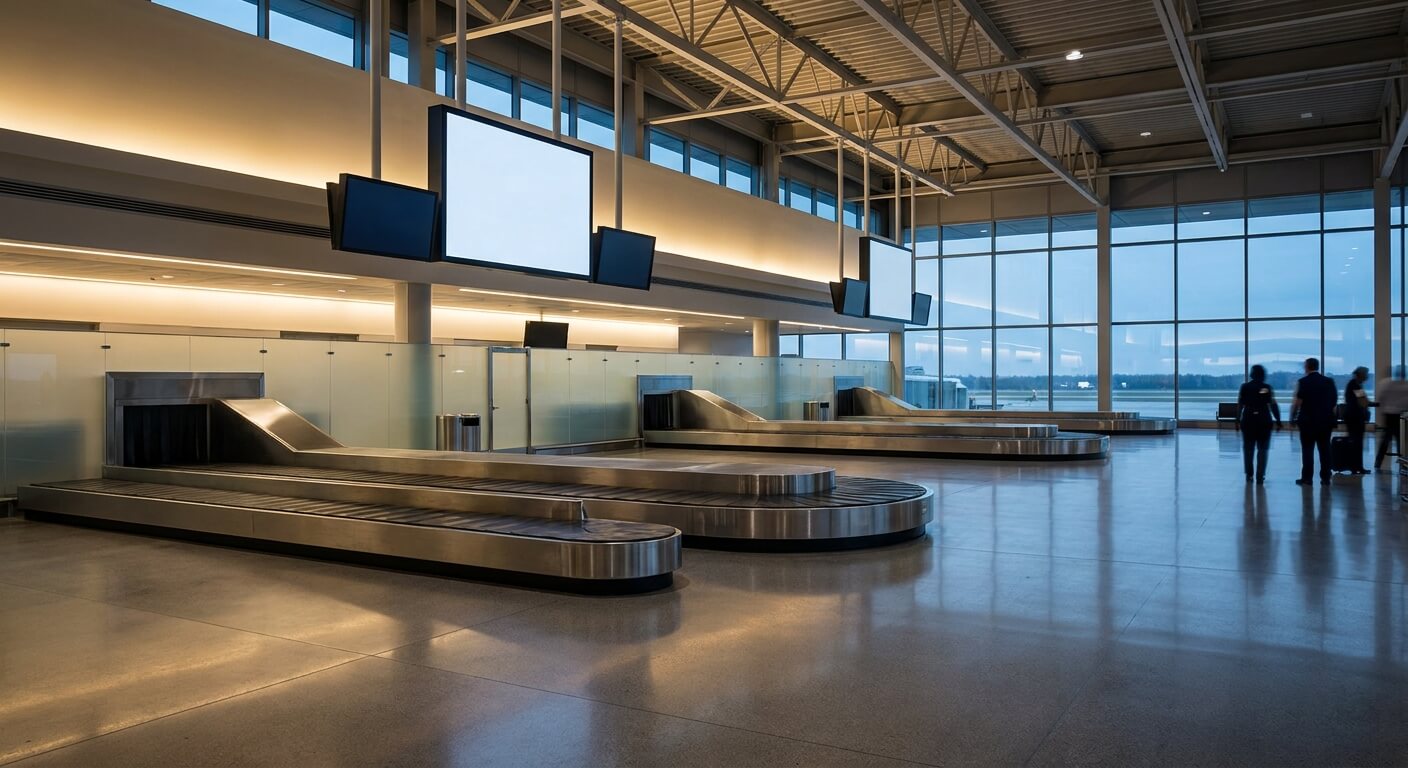
The baggage experience is the lowest-rated touchpoint in commercial aviation. Not by a small margin.
ACI World's global ASQ data consistently places baggage claim and baggage delivery at the bottom of the airport journey — trailing check-in, security, gates, and restrooms by a significant margin across regions and airport sizes. The gap is persistent, structural, and widely documented across passenger satisfaction benchmarks.
The operational question is not whether the gap exists. It is what airports can do about it before the next ASQ report arrives.
Why Baggage Scores Are Structurally Different
Baggage is the one major airport touchpoint where the passenger experience is almost entirely outside the airport's direct control — handled by airlines, ground handling contractors, and third-party operators.
That makes it operationally complex. It does not make it immovable.
The passenger experience at the baggage claim does not begin when the belt starts. It begins the moment the aircraft doors open and the passenger begins calculating how long before their bag arrives. The wait. The information. The crowding. The first impression of whether anything is working.
ACI World's ASQ benchmark data consistently identifies baggage claim and baggage delivery as among the most influential factors on overall satisfaction ratings. A poor baggage experience does not stay isolated in the baggage score. It colors the entire journey rating.
And here is the operational reality: the airport owns the physical environment. The signage. The staffing. The communication infrastructure. The feedback infrastructure. Even when the bag is on an airline belt, the airport controls what the passenger experiences while waiting.
Where Real-Time Feedback Changes the Equation
Airports cannot control every bag. They can control the experience around every bag.
A major hub airport operating real-time feedback at its baggage claim zones found that passenger satisfaction dropped predictably during international arrival waves — specifically during the 18-to-25-minute window before first bags appeared on the belt.
The score drop was not caused by the wait itself. It was caused by two compounding factors: insufficient real-time information about expected first-bag time, and visible overcrowding at claim zones that operations teams were not positioned to manage proactively.
The feedback data identified both factors — not from a post-flight survey, but from signals captured while passengers were still at the carousel. Operations teams received alerts in real time. Staff were repositioned. Digital signage was updated. The interval of unexplained waiting — the friction point — was shortened.
The satisfaction score at that zone improved within two weeks. Not because the bags arrived faster. Because the experience of waiting was actively managed.
The August Problem
August is the worst month for airport passenger satisfaction globally. Summer volume compresses every operational system simultaneously, and baggage handling is the pressure point that buckles first.
Demand-based staffing at baggage claim, proactive signage management, and real-time feedback loops connecting the baggage zone to operations teams are the tools airports with strong summer performance have in common.
The airports that manage August well are not the ones with the most staff. They are the ones with the best operational visibility into what passengers are experiencing — by zone, by flight arrival, by hour — as it is happening.
The Operational Window That Surveys Miss
Post-flight surveys capture the baggage experience after the passenger has left the terminal. By then, the feedback is information. Not intelligence.
Real-time feedback at baggage claim captures the signal while the passenger is still at the carousel. That is the operational window — the period in which an airport can still intervene. Update the information board. Deploy additional staff to the overcrowded zone. Communicate with ground handling about the specific flight.
That window closes the moment the passenger exits. Post-flight surveys open long after it has closed.
The airports closing the baggage satisfaction gap are not waiting for quarterly ASQ reports to tell them which arrival waves had problems. They know within minutes. And they respond within minutes — while the experience is still happening, not after it has been rated.
The Bottom Line
The baggage claim zone is not a policy problem or a contract problem. It is an operational visibility problem.
Airports cannot fix what they cannot see in real time. The baggage claim zone is the highest-risk, lowest-satisfaction touchpoint in the passenger journey. It is also one where airport operations teams have direct ability to improve the surrounding experience — if they have the signal to act on.
Real-time feedback at baggage claim zones closes the gap between what passengers experience and what operations teams can manage. The ASQ score follows the operational improvement. It always does.
See how FeedbackNow deploys real-time feedback across the full airport passenger journey.
Contact us to learn more about how FeedbackNow can help improve your customer experience and operations!