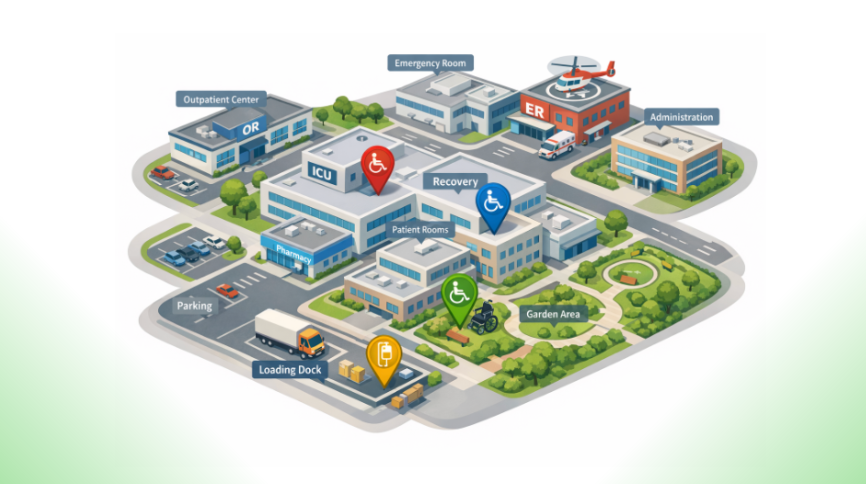
The Hidden Cost of “Where Is It?”
In today’s hospital environment, operational efficiency often comes down to one critical question:
Where is the asset - right now?
- Where is the hospital bed?
- Where is the wheelchair?
- Where is the respiratory pump?
- Did the pharmaceutical shipment arrive within the correct temperature range?
These aren’t minor inconveniences. They are systemic inefficiencies that impact patient flow, staff productivity, and financial performance.
Research from GE Healthcare and Gartner indicates:
- Hospitals can lose $3,000–$5,000 per bed annually due to underutilization
- 10–20% of mobile medical equipment is lost or unaccounted for
- Clinical staff spend up to 30 minutes per shift searching for equipment
For healthcare executives, this translates into millions in avoidable costs and lost productivity.
What Real-Time Asset Tracking Solves
Modern real-time asset tracking solutions powered by BLE, RFID, GPS, and IoT provide continuous visibility into:
- Asset location (ICU, recovery, surgery, outpatient)
- Movement history (when assets arrive and leave)
- Dwell time (how long assets stay in one place)
- Availability levels (what’s in use, idle, or in transit)
This creates a Location-as-a-Service platform that enables hospitals to better manage assets across complex environments.
But visibility alone doesn’t drive outcomes.
The Missing Link: Real-Time Feedback
Even the most advanced tracking systems can’t answer critical operational questions:
- Why is a hospital bed sitting in the hallway?
- Why isn’t a wheelchair available during peak demand?
- Was a delivery handled properly upon arrival?
Data shows location. Feedback explains performance.
FeedbackNow: Turning Asset Tracking into Action
FeedbackNow adds a critical layer of real-time operational intelligence to asset tracking systems.
1. Immediate Issue Identification
- Flag when a bed remains idle too long
- Alert when a wheelchair leaves hospital grounds
- Escalate when critical equipment is unavailable
2. Context Beyond Location Data
Tracking systems might show:
“The wheelchair is in the outdoor garden.”
FeedbackNow reveals:
“The wheelchair has been unavailable for 20 minutes and is impacting patient experience.”
3. AI-Driven Decision Making
By combining:
- Location data
- Utilization patterns
- Real-time feedback
Hospitals can:
- Predict shortages
- Optimize asset distribution
- Reduce unnecessary capital purchases
High-Impact Use Cases
Hospital Beds
- How long did the bed remain in a hallway?
- When was it cleaned and ready for the next patient?
Wheelchairs
- Where are they now?
- Are they available where demand is highest?
- Alert when leaving campus
Critical Equipment (e.g., Respiratory Pumps)
- Is equipment available when needed?
- Are delays impacting care delivery?
Pharmaceutical Deliveries
- Did shipments maintain required temperature conditions?
- Were there delays in receiving or storage?
The ROI of Real-Time Asset Tracking + Feedback
A combined approach delivers measurable outcomes:
- Reduced capital expenditures (fewer replacement purchases)
- Improved labor productivity (less time searching)
- Lower asset loss and shrinkage
- Higher utilization rates
- Improved patient and staff experience
For CFOs, COOs, and hospital administrators, this means lower costs, higher efficiency, and better care delivery.
From Visibility to Real-Time Operational Excellence
Asset tracking answers:
Where is it?
FeedbackNow answers:
Is it working - and what needs attention right now?
Together, they enable:
- Real-time visibility
- Faster, data-driven decisions
- Continuous operational improvement
Because in healthcare, efficiency and patient experience are won - or lost - in real time.
Contact us to learn more about how FeedbackNow can help improve your customer experience and operations!