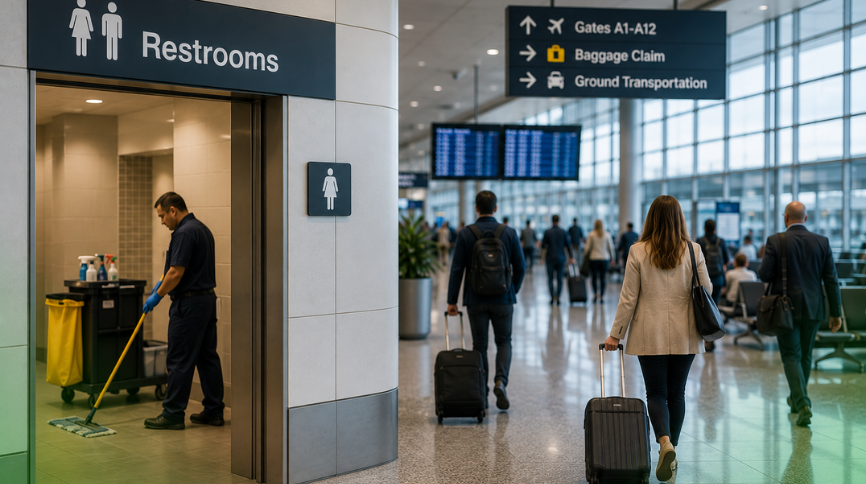
Most airports don't clean their own restrooms. They outsource.
A facilities management company or cleaning contractor is responsible for the passenger's first impression of the terminal - and in most cases, the airport has no real-time visibility into how that contractor is actually performing.
Post-event surveys don't help. By the time a passenger submits negative feedback about a restroom, the window for operational intervention has long closed. The contractor already moved to the next zone. The passenger already formed their impression.
Real-time feedback changes that relationship entirely.
The Problem With Scheduled Cleaning in High-Traffic Terminals
Airport cleaning contracts are typically structured around scheduled cleaning cycles. Zone A is cleaned at 6 AM, 10 AM, 2 PM, and 6 PM. The contractor marks it done. The airport accepts it as done.
There's no mechanism to know whether that 10 AM clean happened before or after the 9:45 AM international arrival that sent 400 passengers through the terminal simultaneously.
Airports Council International (ACI) data is unambiguous: restroom cleanliness is consistently the top driver of passenger satisfaction in airport quality surveys. A 1% improvement in satisfaction generates a **1.5% increase in non-aeronautical revenue**. That's not a soft metric. That's budget-line data.
When cleaning is scheduled and unverified, the airport bears the satisfaction risk of a contractor's schedule. That risk is invisible until it shows up in ACI ASQ benchmarks - quarters later.
What Real-Time Feedback Creates
A major hub airport deployed real-time feedback kiosks across its primary passenger restrooms as part of a broader service provider accountability program. The goal was operational, not evaluative: use feedback data to identify the gaps between a contractor's schedule and actual passenger experience.
The results were immediate. Satisfaction data began showing intraday patterns the airport had never measured before.
The 9:30–10:15 AM window - the peak period for connecting passengers - consistently generated the lowest restroom satisfaction scores of the day. The cleaning cycle that preceded it did not align with the demand surge. The contractor was cleaning to the schedule, not to passenger traffic.
That data became the foundation of a service level conversation. Not anecdotal. Not a complaint. Objective, time-stamped, volume-weighted feedback from real passengers, captured in real time.
Correlating Feedback with Peak Traffic
Airports deploying real-time feedback alongside people counter data gain the most precise picture of contractor performance. People counters measure actual foot traffic by time of day. Feedback devices measure satisfaction at the same touchpoints.
The combination creates a correlation model: when does traffic spike, and when does satisfaction drop relative to that spike?
A mid-size airport using this model discovered that cleaning response times consistently lagged peak foot traffic by 18 to 25 minutes. That lag was not a contractor failure on paper - the scheduled cycles were being completed. It was a scheduling misalignment that only became visible through real-time data.
The fix was not a new contractor. It was a shift in cleaning deployment logic, driven by feedback-informed traffic data. Satisfaction scores in the affected zones improved within the first week after the change.
Alerts Turn the Contractor Relationship from Retrospective to Real-Time
Scheduled cleaning contracts report backwards. Real-time alerts change the model entirely.
When a restroom cluster drops below a satisfaction threshold, an alert routes immediately - to the airport's facilities team, to the contractor's on-site supervisor, or to both. The response window is measured in minutes, not in the next scheduled cycle.
This creates a fundamentally different contractor relationship. The contractor is no longer accountable to a clock. They're accountable to a passenger experience signal. That signal is objective, documented, and time-stamped.
A mid-size airport using alert-based cleaning management reduced restroom dissatisfaction events by more than 30% within the first quarter. The contractor didn't change. The accountability infrastructure did.
Building the Business Case for Better SLAs
Real-time feedback data provides airports with the documentation needed to renegotiate service level agreements from an objective baseline.
Before deployment: "We believe cleaning response times are too slow." Hard to quantify. Easy to dispute.
After deployment: "Between 9:15 and 10:30 AM on 47 of the last 60 days, restroom satisfaction in Terminal B dropped below threshold. Average cleaning response time during those windows was 22 minutes. Contract SLA specifies 15." Harder to dispute.
This is the operational value that translates directly to vendor contract conversations, procurement reviews, and capital planning decisions.
The Broader Accountability Network
Cleaning is the most visible application. But the same model applies to every contracted service at an airport: F&B operators, retail concessionaires, ground handling vendors.
Real-time feedback at F&B touchpoints tells the airport when a concession operator's service speed has created a friction point that's costing transaction volume. Data at gate areas identifies when passenger experience is deteriorating in zones where specific operational partners are responsible.
This is not surveillance. It is operational visibility shared with the partners who need it - so they can respond before a satisfaction dip becomes a trend.
The Bottom Line
Airports that outsource cleaning and operations services are outsourcing the most visible components of passenger experience. Without real-time feedback, that outsourcing comes with a visibility gap that only shows up in quarterly ACI scores and social media reviews.
Real-time data closes that gap - in real time, as the experience is happening. It turns contractor relationships from retrospective to accountable. And it gives airports the objective evidence they need to drive improvement before it becomes a benchmark problem.
See how FeedbackNow helps airports build contractor accountability through real-time feedback. Learn More
Contact us to learn more about how FeedbackNow can help improve your customer experience and operations!