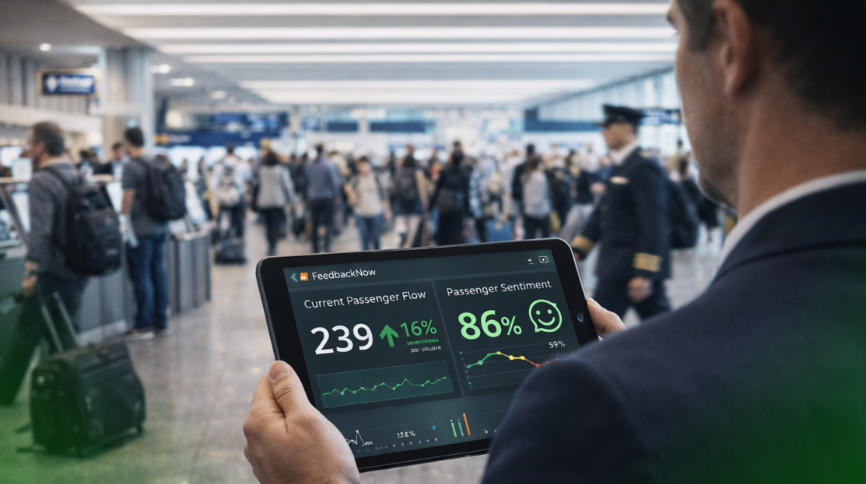
In many organizations, critical operational decisions are still made based on anecdote.
“Gabe said the bathrooms were dirty.”
“Someone mentioned long lines yesterday.”
“I’ve heard complaints about this location.”
These statements are familiar - and dangerous.
Because as organizations scale across locations, teams, and geographies, anecdotal insight doesn’t just become unreliable - it becomes a barrier to performance, accountability, and growth.
The future of operational excellence depends on a fundamental shift: from subjective opinion → to real-time, defensible data.
The Problem with Anecdotal Decision-Making
In smaller environments, informal feedback loops can work. Leaders are close to the operation. Issues are visible. Conversations are direct.
But as organizations grow, this model breaks down:
- Feedback becomes filtered through layers of management
- Issues are inconsistently reported—or not reported at all
- Decisions are influenced by the loudest voice, not the most accurate data
- Internal debates replace objective action
The result is a lack of alignment and a lack of trust in the data that does exist.
According to Deloitte, data-driven organizations are 23x more likely to acquire customers and 19x more likely to be profitable. Yet many frontline operations still rely on subjective inputs rather than measurable signals.
This creates a critical gap between perception and reality.
Why Data Credibility Matters More Than Ever
In high-volume, operationally complex environments — airports, healthcare facilities, retail chains, and service organizations — credibility is everything.
Leaders need to answer questions like:
- Where are we underperforming right now?
- Which locations or shifts need attention?
- Are investments in staffing, cleaning, or infrastructure actually working?
Without credible data, these questions lead to:
- Delayed decisions
- Misallocated resources
- Internal misalignment
- Missed opportunities for improvement
Research from McKinsey & Company shows that organizations that leverage high-quality, real-time data outperform peers in operational efficiency and customer satisfaction.
But credibility isn’t just about having data — it’s about having the right data.
The Difference Between Data and Ground Truth
Not all data is created equal.
Many organizations rely on:
- Periodic surveys with low response rates
- Aggregated reports that lack location-level detail
- Manager-reported insights that may be biased or incomplete
While useful, these sources often fail to capture what’s actually happening on the ground.
Ground truth data, by contrast, has three defining characteristics:
- Immediate – captured at the moment of experience
- Unfiltered – coming directly from the end user
- Granular – tied to a specific location, time, and condition
According to PwC, organizations that prioritize real-time, customer-centric data are better equipped to build trust, improve experiences, and drive operational performance.
Ground truth eliminates ambiguity.
It replaces “I think” with “I know.”
Transforming Internal Conversations
When organizations shift to real-time, credible data, something powerful happens: the conversation changes.
Instead of:
- “We’ve been hearing complaints…”
- “It seems like this location is struggling…”
Teams can say:
- “Customer satisfaction dropped 18% at this location between 2–4 PM.”
- “Traffic exceeded service capacity thresholds, triggering a decline in experience.”
- “This operational change improved sentiment by 12% week-over-week.”
This shift has cascading effects:
- Faster, more confident decision-making
- Reduced internal friction and debate
- Clear accountability at the location and team level
- Stronger justification for operational investments
Data becomes not just informative — but authoritative.
Building Accountability at Scale
Credible, real-time data doesn’t just inform decisions—it drives accountability.
When performance is visible:
- Teams understand expectations more clearly
- Leaders can pinpoint where action is needed
- Best practices can be identified and scaled
- Underperformance can be addressed quickly and objectively
This is especially critical in distributed operations, where consistency across locations is a constant challenge.
With ground truth data, accountability is no longer subjective — it’s measurable.
How FeedbackNow Creates a Source of Truth
This is where FeedbackNow delivers transformational value.
By capturing feedback directly from customers and end users at the moment of experience, FeedbackNow provides a continuous stream of real-time, location-specific data.
The result is a true operational “source of truth”:
- High-frequency feedback that reflects actual conditions — not a small sample
- Immediate visibility into performance across locations and time periods
- Unbiased input directly from the people experiencing the service
- Actionable insights that tie directly to operational decisions
Instead of relying on secondhand reports or delayed surveys, organizations gain direct access to what’s happening on the ground — right now.
From Opinion to Precision
As organizations grow, the cost of bad decisions increases.
Relying on anecdote and assumption is no longer sustainable.
The shift to real-time, credible data is not just a technology upgrade — it’s an operational transformation:
- From opinion → to precision
- From debate → to alignment
- From reaction → to proactive management
The organizations that lead will be those that replace “Gabe said” with ground truth - and use that truth to drive better decisions, better experiences, and better outcomes.
SOURCES
- McKinsey & Company — The Data-Driven Enterprise of 2025
https://www.mckinsey.com/capabilities/quantumblack/our-insights/the-data-driven-enterprise-of-2025
- PwC — Experience is Everything: Here’s How to Get It Right
https://www.pwc.com/us/en/services/consulting/library/consumer-intelligence-series/future-of-customer-experience.html
Contact us to learn more about how FeedbackNow can help improve your customer experience and operations!