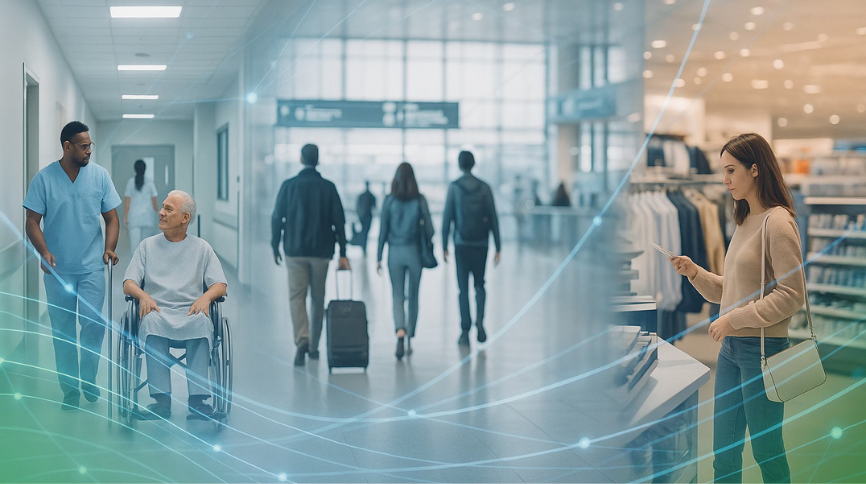
As 2025 comes to a close, one thing is clear: real-time feedback has become a cornerstone of modern operations.
Hospitals, airports, retailers, manufacturers, and event venues no longer ask “Should we collect real-time feedback?” - they ask “How far can we take it?”
At FeedbackNow, we’ve seen that question answered in remarkable ways. Our partners — from Montefiore and the VA Hospitals, to Grandi Stazioni, La Colonia, the New York & New Jersey Port Authority, and the Georgia World Congress Center - have shown how live awareness can transform both customer experience and operational agility.
As we move into 2026, real-time feedback is entering its most exciting phase yet — one defined by new devices, smarter sensors, expanded business functions, and deeper integration into the fabric of daily operations.
Here’s what the future of feedback looks like.
1. Feedback Will Expand to New On-Site Touchpoints
In 2026, real-time feedback will extend far beyond traditional points like restrooms or lobbies.
Retailers will capture feedback at checkout counters, dressing rooms, and pick-up points; airports will collect it from security lines and baggage claims; manufacturers will monitor it along production floors and break zones.
The goal: to understand the entire journey - from front-of-house to back-office.
FeedbackNow’s portable and embedded terminals make it possible to listen anywhere, seamlessly integrating feedback into environments that once seemed too busy or complex.
The next generation of listening happens wherever people interact - not just where it’s convenient.
2. New Devices Will Redefine How Feedback Feels
The coming year will usher in a new wave of FeedbackNow devices designed for flexibility, design, and speed. Expect slimmer terminals, modular mounts, and advanced connectivity options for deployment in retail aisles, airport gates, hospital wings, and beyond.
Touchless, voice-enabled, and gesture-based interfaces will make feedback even more natural. Imagine a shopper giving feedback with a quick hand wave near a smart shelf, or a traveler leaving instant input through a wall-mounted terminal on their way to a gate.
2026 devices won’t interrupt the experience - they’ll blend into it.
3. Sensors Will Deliver New Dimensions of Insight
In 2025, organizations began linking human sentiment with environmental conditions - pairing feedback with data on temperature, air quality, and noise. In 2026, this integration will accelerate.
New sensors will measure lighting quality, crowd density, energy use, and ambient comfort - turning operational environments into data-rich ecosystems.
For example, a retailer like La Colonia could correlate feedback dips with temperature spikes or lighting inconsistencies across store locations, enabling precise adjustments that elevate both comfort and sales.
In hospitals or transportation hubs, environmental sensors will help maintain standards for cleanliness, safety, and accessibility, creating conditions that support better experiences and outcomes.
2026 will be the year feedback learns to “see” its environment.
4. Real-Time Feedback Will Reach New Corners of the Business
For years, real-time feedback primarily lived within facilities or customer experience teams. In 2026, its reach will expand dramatically across business functions.
- Retail operations will use feedback to improve merchandising layouts, staff scheduling, and service consistency across regions.
- HR and workforce teams will use employee feedback to measure engagement and safety in real time.
- Compliance and sustainability leaders will monitor environmental standards continuously via sensor-linked dashboards.
- Finance and strategy teams will tie feedback trends directly to revenue, brand reputation, and retention.
The result? Feedback becomes a unifying operational language - connecting departments that used to work in silos.
In 2026, every function becomes a real-time feedback function.
5. AI Will Drive Predictive and Personalized Response
Artificial intelligence will elevate real-time feedback from reactive monitoring to predictive precision.
FeedbackNow’s AI-powered analytics already detect anomalies and anticipate issues before they occur. In 2026, expect these capabilities to become more adaptive - learning from customer patterns, environmental data, and time-based trends to forecast what’s next.
In a retail setting, this could mean predicting when certain locations are likely to see drops in satisfaction due to staffing patterns or seasonal crowding. In healthcare, it could mean anticipating patient comfort issues before they arise.
AI will make feedback not just faster - but foresighted.
6. Real-Time Feedback Will Become a Connected Ecosystem
2026 will also mark the era of integration. Real-time feedback systems will sync with a broader network of operational platforms - including CRM tools, building automation systems, and workforce management software.
At FeedbackNow, we’re already making this possible, allowing live feedback to trigger automated workflows: dispatching cleaning crews, adjusting HVAC systems, or alerting managers based on thresholds.
For multi-location retailers like La Colonia, this means feedback can drive tangible, automated improvements - instantly and consistently across the brand.
The future isn’t just real-time - it’s real-time connected.
The Bottom Line: From Listening to Learning
If 2025 was the year organizations embraced real-time awareness, 2026 will be the year they perfect it. We’ll see smarter devices, richer data, and broader adoption across industries - from retail floors to runways, hospitals to headquarters.
At FeedbackNow, we’re proud to lead this evolution - helping organizations everywhere turn live feedback into lasting advantage.
Contact us to learn more about how FeedbackNow can help improve your customer experience and operations!